Showing posts with label WBRC In the News. Show all posts

April 15, 2014

VisionAware Publishes Article About WBRC's CNVR Program

Photo: John Kingston works with a veteran on the NVT light panel for scanning training.
VisionAware has published an article by Mary D'Apice about the WBRC's Comprehensive Neurological Vision Rehabilitation (CNVR) program  for veterans and active duty service members with Traumatic Brain Injury (TBI) related vision loss.  The article included a review of some types TBI related vision loss and some of the specialized treatment that the WBRC provides to enhance the ability of people with TBI related vision loss to use their remaining vision. 

CLICK HERE to read the VisionAware Article

CLICK HERE to learn more about the WBRC CNVR Program

December 16, 2013

WBRC Visited By VA Assistant Secretary for Public and Intergovernmental Affairs

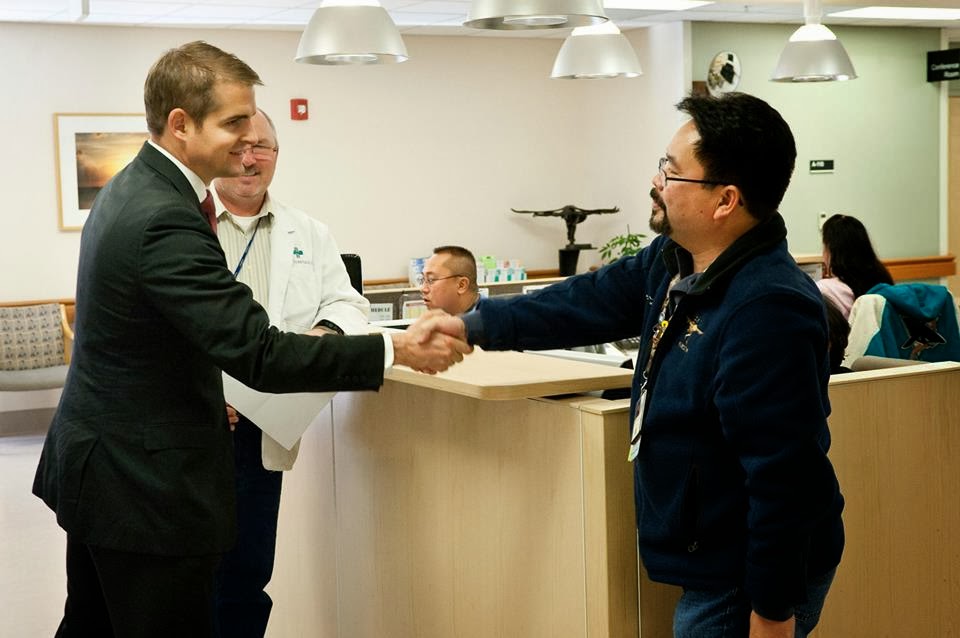
Photo: Dr. Tommy Sowers meets Jeremy Adriano, WBRC Assistant RN Manager
VA Assistant Secretary for Public and Intergovernmental Affairs Dr. Tommy Sowers visited the VAPAHCS Menlo Park campus last week to meet staff running the Western Blind Rehab Center, National Center for PTSD and Domiciliary.  As Assistant Secretary, Dr. Sowers represents and advises the Secretary of Veterans Affairs on matters relating to media relations, public affairs, and intergovernmental affairs. He directs departmental communications and oversees programs involving intergovernmental relations including homeless Veterans, consumer affairs, rehabilitative special events, VA’s Office for Tribal Governments, and the VA Outreach Office.

Photo: Dr. Sowers meets Tina Zamora, WBRC Ward Clerk
The Western Blind Rehabilitation Center (WBRC) is a 27-bed residential facility located at the Menlo Park Division of the VA Palo Alto Health Care System. Approximately two hundred men and women of all ages participate in the program each year. More than three quarters have usable vision for which specialized treatment is provided. Adjusting to and managing visual impairment is the major objective of the program.  If you are in the area and are interested in a site visit, please call (650) 614-9952 to make arrangements.

CLICK HERE to learn more about the WBRC

CLICK HERE to see more photographs of Dr. Sowers visit

CLICK HERE to learn more about Dr. Sowers

October 25, 2012

Palo Alto Online Documents the 2012 White Cane Awareness Walk

Visually impaired veterans and volunteers wait to cross the street on Forest Avenue in Palo Alto during a walk to celebrate "White Cane Awareness Day" on Oct. 24, 2012. Photo by Veronica Weber/Palo Alto Online.
Palo Alto Online Magazine participated in the 2012 White Cane Awareness Day Walk by sending Veronica Weber to photograph and document the event.  They posted a short article on their website with 4 photographs of the event.  WBRC would like to express a big thank you to Palo Alto Online and all of the 2012 White Cane Awareness Day Walk participants and sponsors for making the event such a success.

CLICK HERE for the Palo Alto Online Article & Photos

CLICK HERE for the WBRC Blog Post & Photos 

January 6, 2012

Blast From the Past: 1978 WBRC Open House Article

Image: Palo Alto Times newspaper clipping from 1978

Brian Higgins, WBRC CATs Supervisor, found this 1978 Palo Alto Times newspaper clipping while unpacking from our recent move to Menlo Park.  The short article titled ‘VA Blind Center Slates Open House’, describes a WBRC open house scheduled for February 21, 1978, shortly after the WBRC moved from Menlo Park to a newly constructed building [48] on the Palo Alto hospital grounds.  Following below is a typed copy of the article in it's entirety.

‘VA Blind Center Slates Open House’
               [February 17th, 1978] The new $2.9 Million Western Blind Rehabilitation Center at the Palo Alto Veterans Administration Hospital has planned an open house from 2 to 4 p.m. Tuesday, Feb. 21.
                The building is the first in the VA system designed and built exclusively for dealing with problems related to blindness and low vision.
                The two-story building, located on the northwest portion of the grounds of the Palo Alto VA hospital, has 38,000 square feet of floor space.  It’s unusual F-shaped design makes it easier for the blind veterans to learn their way around.
                Other features include distinct color schemes enabling low vision patients to distinguish readily between sections within the building, individually controlled lighting and temperature and piped in music.
                The center can accommodate up to 30 inpatients, both men and women.  It serves veterans from the western states.
                At the open house, representatives from the VA central office in Washington, D.C., the Palo Alto VA hospital and the American Foundation for the Blind will participate in a ceremony beginning at 2 p.m.  At 3 p.m. the doors will be open to the public.  The Staff and patients will be available to answer questions.
                The center provides a multidisciplinary, individualized treatment of the problems of adjusting to loss of sight.  Programs include providing the visually impaired veteran with alternative methods of communicating, developing sensory and organizational skills and self confidence, teaching the blind to travel safely and independently, providing recreational activities such as swimming and bowling, and assisting the veteran’s adjustment into his family and community.
                In addition, the center focuses on research and development of devices to alleviate the difficulties experienced by people adjusting to sight loss.

November 9, 2011

WBRC Receives Move Dates


Photo: Cardboard Box with words 'Moving Day' written on
side, sharpie marker, and packing tape.

WBRC received news of the dates for our move to our new site at the Menlo Park VA Hospital Campus.  The planned dates for the move are from December 2nd to December 6th.  WBRC will be moving into a newly constructed 42,000 square foot facility.

The move to the Menlo Park location will be temporary while a new Polytrauma and Blind Rehabilitation Center is built on the Palo Alto VA Hospital Campus.  The anticipated start date of that construction is May 2012 with anticipated completion in March 2014.

CLICK HERE to learn more about our New Menlo Park Location

CLICK HERE to learn more about the plans for the New Rehabilitation Center at Palo Alto

CLICK HERE to read the News Release regarding the contract to build the New Rehabilitation Center at Palo Alto
 

November 7, 2011

Stanford School of Medicine Website Reviews VA Palo Alto Construction Projects

The Stanford School of Medicine website has written an article reviewing the numerous construction projects at the VA Palo Alto Hospital campus and how these projects will impact their students.  Excerpts from the article follow below:

Image: Rendering of the front of the new Blind Rehabilitation
Center and Polytrauma Building planned for the Palo Alto Campus

'Huge VA Project to Boost Med School Mission'
October 24, 2011
BY JONATHAN RABINOVITZ

'A dozen state-of the-art buildings that will advance the medical school’s clinical, educational and research missions are beginning to rise, but Stanford isn’t leading the effort.

With a construction budget of more than $1 billion, the Veterans Affairs Palo Alto Health Care System, or VAPAHCS, has launched an ambitious building project on its flagship campus on Miranda Avenue in Palo Alto, leaving almost no spot of the 93-acre site untouched. The plan includes a new mental health center; the Department of Veterans Affairs’ largest rehabilitation center, which will combine polytrauma and blind rehabilitation; additional research space; and additional lodging facilities for veteran patients and family members.

The project is driven by an emphasis on patient-centric care and concerns about seismic safety. The project is also part of a broader shift by the VA and health care in general toward more outpatient services, concentrating the most advanced tertiary care services at flagship facilities, such as the Palo Alto site. VAPAHCS, in addition to revamping and expanding its outpatient facilities outside the Palo Alto campus, is taking steps to ensure that its main campus continues to offer the latest treatment modalities and meet new and pressing needs, such as those of the increasing numbers of veterans who have suffered multiple injuries, including traumatic brain injury. As part of that process, VAPAHCS is enhancing its 50-year affiliation with the School of Medicine, adding space for the education of Stanford doctors who treat veterans and the research by Stanford faculty on injuries and illness that affect veterans and others.
“Our success is predicated in part on the success of Stanford medical school,” said Jason Nietupski, the VAPAHCS director of planning and development. “The more successful Stanford is, the more successful our programs are.”

VAPAHCS spans a 10-county, 13,500-square mile region encompassing 275,000 veterans. It had research expenditures of approximately $75 million in 2010, the second- largest research program in the national VA network, supporting 200 principal investigators, including about 90 faculty members from the medical school. This year, VAPAHCS is training 750 residents and fellows and 211 medical students from the School of Medicine. It has more Centers of Excellence — programs with special emphasis — than any other VA health-care system nationwide, and thousands of veterans are referred each year from outside its catchment area to benefit from the expertise, and specialized services it offers...

The Palo Alto campus is one of five facilities in the country designated by the VA to provide intensive rehabilitative care to veterans and service members who have multiple traumas. At 174,000 square feet, the new building will be the largest rehabilitation center in the federal government, with 24 beds for polytrauma/physical medicine and rehabilitation, or PM&R, patients; 32 beds for the blind rehabilitation program; and 12 beds for the polytrauma transitional program, which teaches disabled veterans such daily activities as driving and cooking. The new facility will co-locate inpatient and outpatient rehabilitation programs including PM&R, physical therapy, occupational therapy, and polytrauma and blind rehabilitation within a single state-of-the-art treatment center.

This new rehabilitation center will consolidate providers of polytrauma and vision rehabilitation, who are now distributed around the Palo Alto campus into the same facility.

“The entire system of care for polytrauma and vision-loss patients will be in one building, and that in itself will augment the care we provide,” said Odette Harris, MD, an associate professor of neurosurgery and the VAPAHCS associate chief of staff for polytrauma, who is also director of the Palo Alto site of the Department of Defense-supported Defense and Veterans Brain Injury Center...

When completed in 2014, the building will also impact the Stanford trainees in the physical medicine and rehabilitation residency, who provide care for the polytrauma patients. “It’s a top-notch residency, and this building will only make it better,” said Harris.'

CLICK HERE for a link to the FULL ARTICLE

CLICK HERE for more information about the Rehabilitation Center Plans

April 20, 2011

VA Palo Alto Website Covers Golf Program

Nicole Marquez, WBRC Recreation Therapist, and a golf pro

coach a WBRC Student on his golf swing


The VA Palo Alto Hospital website outlined a new golf program project in which many of the WBRC veterans and staff are involved in. Most of the article follows below:


'Wounded Veterans Find Recovery on the Green'


A big blue sky invites flying golf balls and green grass is waiting to be aerated by golf shoes. The only problem is there are no members on the golf course of the Sharon Heights Country Club (SHCC) in Menlo Park, CA. The only golfers here are wounded Veterans from VA Palo Alto Health Care System (VAPAHCS), invited by the board members of the SHCC to participate in a one-of-a-kind golf clinic that they hope to branch out to other golf courses that want to take part in the healing process of these wounded warriors.


"Our Veterans are blind, paralyzed, and/or have traumatic brain injuries. This program takes away a lot of the intimidation of going to a golf course and trying to figure it out alone," said Nicole Marquez, recreation therapist at VAPAHCS [at the WBRC]. "This creates a safe zone where they are able to make mistakes and learn. It also helps them to reintegrate back into the community and find confidence that they can still do things they did before their injuries."


Nicole and many other recreation therapists work with wounded Veterans every day at VAPAHCS to help them cope with their injuries and facilitate rehabilitation.


"The main idea is just helping Veterans," said Marty Connelly, SHCC member and one of the catalysts in getting the clinic off the ground. "Our club has resources that could be beneficial for Veterans, and this is something that needs to be part of our lives. Everyone benefits - Veterans, families and golfers.


"The board and members of the SHCC approved the project in March 2011. They continue to grow the program by working with sporting goods manufacturers to receive special golfing equipment and recently purchased a new golf system called SNAG to help golf instruction for the VA Palo Alto campus.


"When Marty and Gary brought this proposal to us, we endorsed it 100 percent," said George Cavender, President of the SHCC Board. He and other board members come to each clinic to support and help out any way they can. The golf course is closed the day of the clinic and is set up so each Veteran is paired with a golf pro instructor at the driving range. The pro helps beginners learn the rules, how to swing their club, and learn to putt on the green. More experienced Veteran golfers are helped to improve their swing and will eventually be taken out on the course for a game.


"In the beginning, it was hard because of my traumatic brain injury (TBI) and I didn't have much confidence," said Peter Rodriguez, who has no vision in his left eye and can only see from his upper quadrant in his right eye. "My instructor told me to just breathe and relax; then the ball started going straighter and farther!"


After suffering a TBI during a tour in Afghanistan, Rodriguez came to VA Palo Alto with his wife for rehabilitation at the Western Blind Rehabilitation Center (WBRC). They plan to retire in Florida where they can be close to a VA medical center and have plenty of places to golf.


"For my husband to be golfing is amazing," said Yolanda Cruz, wife of Rodriguez. "This was one of his goals before he was injured and he thought he would never be able to try it out. I'm so happy that he is able to practice, no matter what."


November 12, 2010

WBRC CNVR PROGRAM PROFILED ON NPR

WBRC Researcher, Dr. Greg Goodrich, pictured in the
WBRC Advanced Wood Shop

Monday November 8th, 2010: Bay Area NPR station KQED aired a radio story regarding the vision research and treatment for Veterans with Traumatic Brain Injury related vision loss occurring at the Palo Alto VA.

Article Excerpt:

"Often people don't realize they have the problem," says Greg Goodrich, a vision researcher at the VA Medical Center in Palo Alto.

In 2003, Goodrich and another doctor started noticing something surprising in the young vets they were treating. According to their charts, these men and women could see just fine. Goodrich says many of them had full 20/20 vision. And yet, he says, "they had this huge hemianopsia. Half their visual world was gone. And the most common visual tests used didn’t catch it."

Glenn Cockerham, chief of ophthalmology at the VA Palo Alto, says he and others took to calling these "occult" injuries, because of the way they seemed to escape detection.
"If you just ask [these soldiers] how they’re doing," he says, "they’ll say I’m doing fine. But if you ask specific questions, and you compare them to other people, they’re not doing so well.

For example, many of the veterans were having problems concentrating. They bumped into things. Goodrich says another red flag was when a soldier would say he or she had lost interest in reading. If asked whether that had been the case before the war, the vets would often say that it had not.

What's striking, say the doctors, is that these symptoms -- difficulty concentrating, clumsiness, inability to read well -- are precisely the kinds of problems soldiers might attribute to PTSD, or other combat injuries. Many soldiers assume they are just a fact of life after war.

Returning to civilian life, says Goodrich, is "a tremendous psychological readjustment to go through. And sorting out symptoms that can be subtle, or that you don’t recognize, is a real challenge." Cockerham and Goodrich find that hemianopsias and other vision injuries are far more common than anyone had expected. Goodrich estimates that at least six thousand vets have suffered visual damage as a result of brain injury. "Because some of these are very subtle," says Goodrich, "we don’t catch them as often as we would like to."

One reason that so many vision problems go undiagnosed is that soldiers often don't realize they've been injured at all. For example, just being near an IED blast can, in some case, be enough to sustain brain injury, including vision problems.

"Blasts have this huge pressure wave that comes from them," explains Goodrich, "and the pressure wave does some rather unique things."

In a human body, that sudden pressure wave is like a powerful punch to the chest and stomach. The impact moves throughout the body, including to the brain where it can stretch or tear actual brain tissue. Brain cells can start to die off. If this damage takes place in the visual parts of the brain, that can mean vision problems, including hemianopsias.

Nowadays, far more of these problems are being diagnosed. That’s because Goodrich and Cockerham have invented a new, advanced vision test. It’s now part of the routine screening that veterans receive when they come to the hospital with major injuries.

And that means more vets are getting treatment.

On the day I visited the VA in Palo Alto, Iraq vet Chris Rader was being treated for a hemianopsia he sustained in a motorcycle accident, after he returned from the war.
As he walked down a hallway at the VA, Rader methodically turned his head from left to right, as if watching a tennis match. He was looking for pink post-it notes, placed here and there by Rader’s vision therapist, John Kingston.

Learning how to scan a scene is one way that hemianopsia patients, like Rader, can learn to get around better...

Goodrich says that for many vets, what comes before treatment – the simple act of diagnosis -- is just as important. "Part of my motivation is, I’m a Vietnam vet," he says, "and for some of my comrades, diagnosing the problems that happened to them took 15 to 20 years."

Article Excerpt from kqed.org, 'VA Doctors Solve a Medical Mystery', Written by: Amy Standen

To Read the Full KQED NPR Article CLICK HERE

To listen to the Full KQED NPR Audio Story CLICK HERE

January 29, 2010

WBRC PROGRAM ON ABC NEWS

Talking GPS Helps Blind Travel Freely
December 20th, 2010

By: Carolyn Johnson

PALO ALTO, CA (KGO) -- Walt Sullens recently took an almost perfect stroll through downtown Palo Alto. If only the view had been better. "Right now, every day's a foggy day, even a bright sunny day," he told ABC 7.
That fog is the result of a condition called macular degeneration. "Macular degeneration blocks out your central vision. It's like trying to look through your fist," he described. "It makes it a little difficult to read street signs."
But, on this walk, Sullens got some help to find the street signs and his destination from a device more commonly found in cars. He is being trained to use a specialized GPS by an Orientation and Mobility Specialist at the WBRC Blind Center at the VA hospital in Palo Alto. The device, known as a Trekker, is adapted for use by the blind.
"What's different about it, is it's about the same size as a regular handheld device, but it's got a tactile keyboard overlay to allow them to access the information," explained Laura Koehler with the VA hospital in Palo Alto.
Using his sense of touch Sullens can cycle through a list of options. The GPS figures out where he is and he tells it where he wants to go. He demonstrated how he could get to Borders book store.
"I'm pushing enter to choose Borders bookstore," he said.
"Please head toward Waverly Street crossing Hamilton Avenue," the machine responded.
"And, off I go," said Sullens.
The device gave Sullens the street names and the layout of the intersections he was approaching, but he still had to navigate the traffic and red lights using his own hearing and white cane. As he walked further along, the GPS began describing the neighborhood, giving him a chance to learn it the way a seeing person would.
"Union Bank of California, nearby. Palo Alto Sports shop and Toy World, on your left. Michael's Gelato and Cafe, on your right," the GPS stated, indicating various details about the trip.
"It's very freeing to be able to walk down the street and just explore the environment, something we take so for granted," Koehler explained.
The software is geared toward walking, and steers away from freeways and busy expressways that a normal GPS might favor. In about half an hour, Sullens was closing in on his mark.
"You have reached your destination. Borders, on your right," said the GPS.
"It's right here," said Sullens. "And, it's a nice open place to be. Voila!"
Once he masters the technology he will take the device and a new found sense of freedom back to his home in southern California.
"This is letting me out of the bottle, to give me the freedom to walk around my town," he said.

Please
Click HERE for a Link to the ABC News Clip
Please

CLICK HERE for a Link to the TREKKER Website